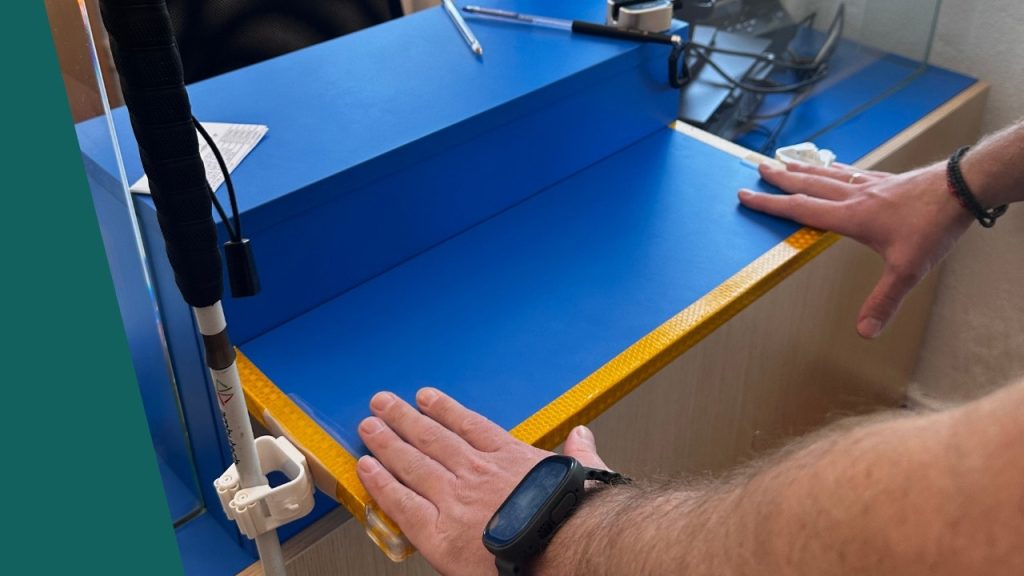
What makes a public space truly accessible to a person with a visual impairment? A tactile guide path that helps them find their way? A counter that stands out from the rest of the room? Preventing a hazard they cannot see? Or a detail, such as where to rest their white cane when they reach the counter?
The answer is all of these together.
A new accessible Service Office for People with Disabilities has been created at the Panorama Citizens’ Service Center (KEP) of the Municipality of Pylaia-Chortiatis. As part of this project, Accessibility Support Academy undertook and delivered the accessibility work for people with visual impairments.
Our role in the Panorama Center project
The Office is the result of cooperation between many people, with the participation of Giannis Kastouras, the Municipality’s Accessibility Consultant. The overall project also provides for serving wheelchair users and Deaf and hard of hearing citizens.
The accessibility work for people with visual impairments was delivered by Accessibility Support Academy with the support of the Education and Rehabilitation Center for the Blind (KEAT (opens in a new tab)), the public body supervised by the Ministry of Social Cohesion and Family.
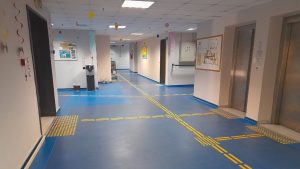
Our own subject was visual impairment: the technical assessment, supply and installation of a tactile guide path system, so that a person with a visual impairment can move with greater safety and independence from the entrance to the service point.
In practice, the work did not stop at the guide path. When we looked at how the space works from day to day, we found other things that affect safety, orientation and the experience of being served.
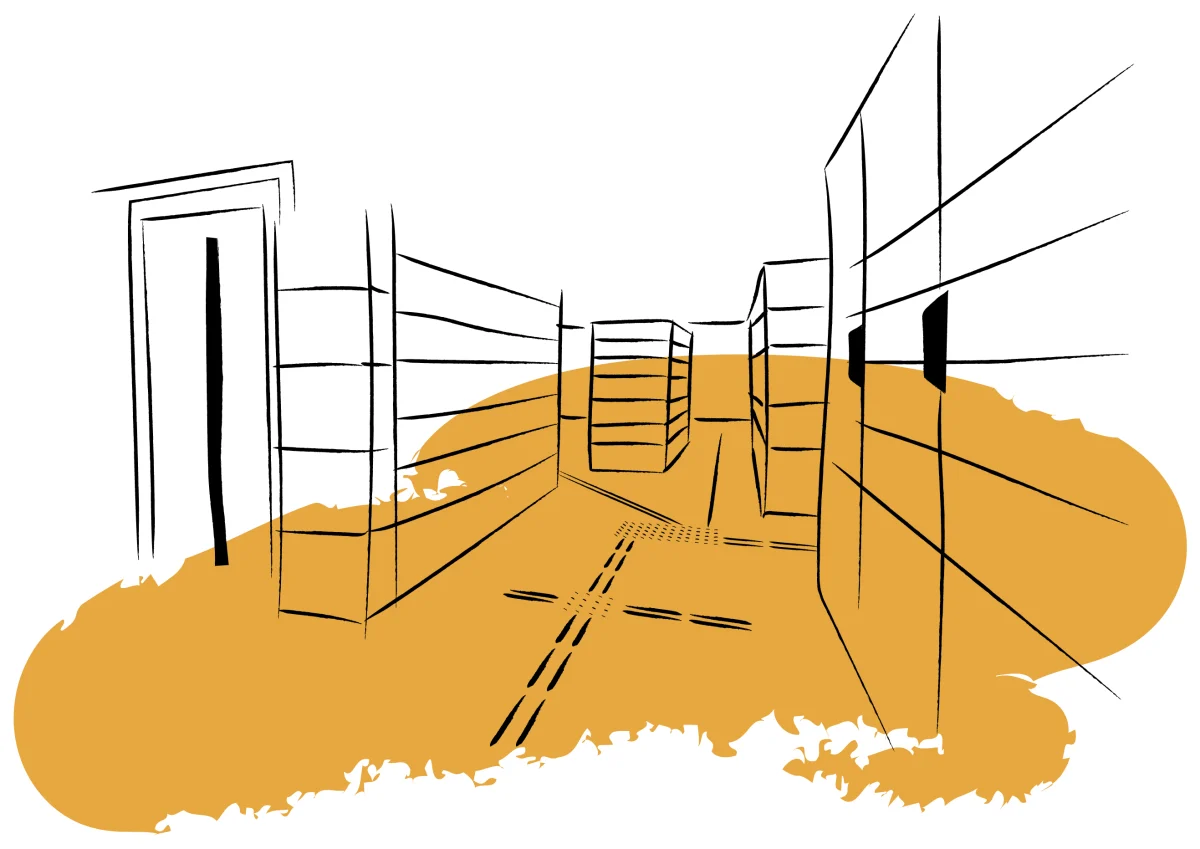
Tactile guide path: from the entrance to the counter
The final route was shaped after an on-site assessment, based on the real conditions of the space. A drawing records dimensions and positions. It does not always show how a person moves through a space that is in use every day.
That is why we examined the way from the entrance to the service point and chose the route that best supports safe movement.
Color contrast at the service point
Visual impairment does not always mean total loss of sight. Many people keep some vision, and for them good contrast is a tool for orientation. Here we placed a yellow marking strip along the edge of the blue counter.
White cane holders on both sides
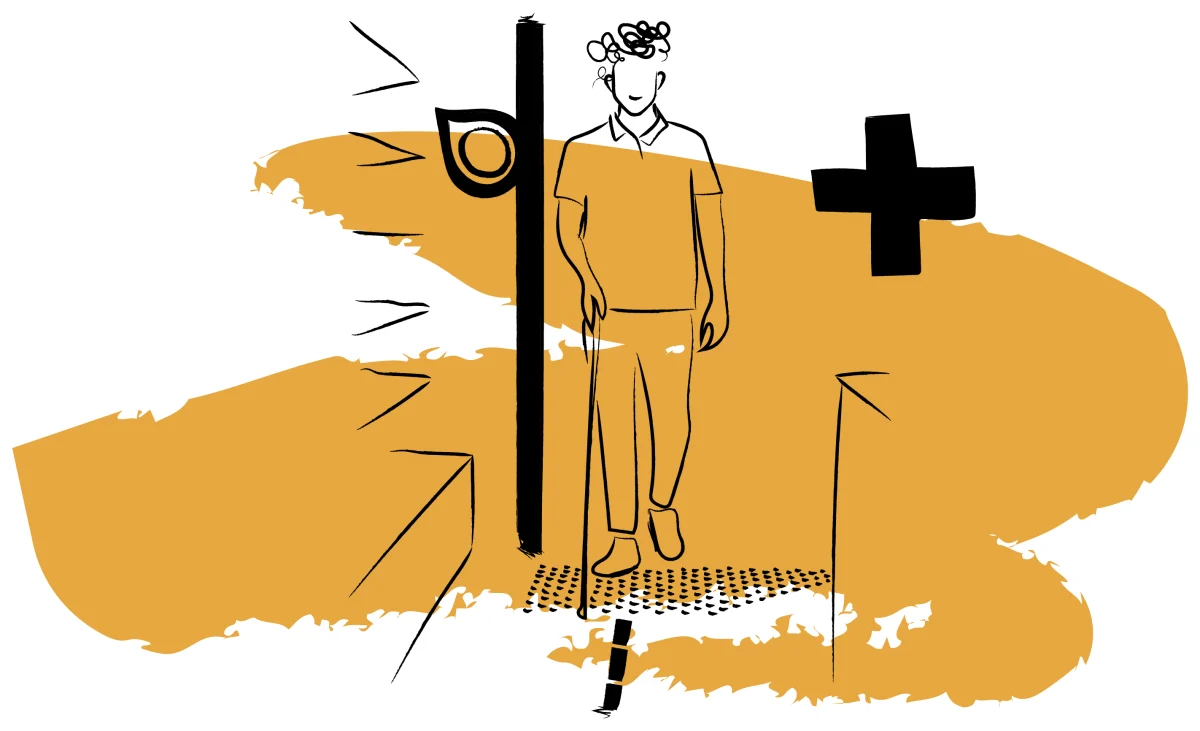
When a white cane user reaches the counter, they need a safe place to leave it. Otherwise the cane falls, gets in the way or stays in their hand throughout the transaction.
We fitted holders on the left and on the right of the counter. People do not all use a white cane in the same way, and the spot should serve left-handed and right-handed users equally.
It is a small intervention in size. But it shows clearly what inclusive design means: we do not assume there is only one way to use a space.
Safety: the hazards that go unnoticed
Electrical sockets
During the assessment we found sockets in places where a person with a visual impairment could touch them unintentionally. We fitted suitable protective covers to reduce the risk of electric shock.
A window at head height
Elsewhere there was a less obvious hazard: a window that, when open, juts into the walking route at head height.
A sighted person notices it at once. A white cane, however, checks the floor and does not detect an obstacle that high in time, so the risk of injury is real.
Here the solution was not a product. It was advice. We informed the staff of the Center about the hazard, so that the window is not left open in a way that creates an obstacle.
This example shows what an accessibility consultant does in practice. They look at what needs to be added to a space, and also at what creates an obstacle through the way the space is used every day.
Accessibility means seeing a space differently
A Citizens’ Service Center is where people meet public administration every day. Being able to enter, find your way, move around and be served safely is part of the quality of the service itself.
At Accessibility Support Academy we combine technical knowledge, on-site assessment and an understanding of the real experience of people with disabilities. Often the difference does not lie in the biggest intervention. It lies in the hazard no one had noticed, in the place where a white cane will rest, in a daily habit that changes.
The Office was officially presented on 4 September 2026, in the presence of the Minister of Social Cohesion and Family, Domna Michailidou, and the Mayor of Pylaia-Chortiatis, Ignatios Kaitezidis. Their presence shows how much meaningful accessibility matters in the services that serve citizens every day.
This is what accessibility in practice means to us.
Would you like us to look at your own space in the same way? See our services for accessibility in buildings or contact us.
Frequently asked questions
Is a tactile guide path enough to make a space accessible to people with visual impairments?
No. The guide path covers the route. Color contrast at service points, checks for hazards at body and head height and informing the staff are needed too.
Why does color contrast matter?
Because many people with visual impairments keep some vision. Strong contrast helps them recognize a counter, an edge or an object and find their way.
Why is an open window a hazard for a white cane user?
Because a white cane detects obstacles low down, on the floor. An obstacle that protrudes at head height is often not noticed in time.